
When the Signal Gets Lost
Organizations generate an abundance of performance data. Some insights stand out; most are buried in noise. The solution is rarely more measurement, more data, or more dashboards. The breakthrough comes from creating the clarity and shared meaning that allow existing investments to function as a coherent system—one that makes the right actions unmistakable.
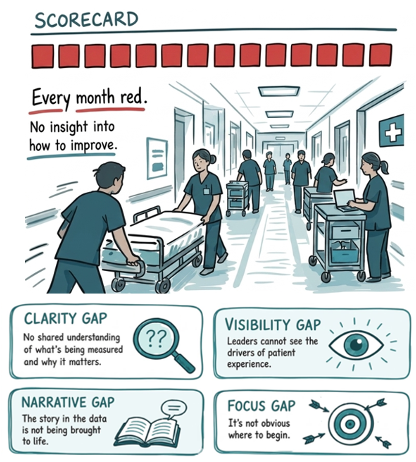
Surrounded by Metrics but Starved for Meaning
As the flagship academic medical center of a leading regional health system, serving more than 80,000 emergency department patients annually, the organization possessed no shortage of data. It had invested heavily in comprehensive measurement, modern analytics, and a robust monthly patient experience scorecard.
Yet, despite these investments, the organization hit a familiar ceiling. The monthly scorecard registered 16 consecutive months of red performance.
A System That Turned Everyday Work into Heroics
The context mattered. The department’s culture, history, and daily realities shaped every aspect of the experience. Meaningful change required understanding that environment first—how the work actually unfolded, what pressures shaped behavior, and where the system was quietly constraining performance. That is always where The Outcomes Institute begins.
The first signal of what truly needed to change didn’t come from data; it came from the people living inside the system every day. During early discovery, a staff member said, almost as a confession,
“I clean up everybody’s mess… I cannot work in clutter.”
It wasn’t really about clutter. It was about the daily scramble. People stretching, improvising, and doing work outside their role because the system left them no other choice. You could hear the strain in the way they talked about it. The workarounds. The frustration. The feeling of holding things together with sheer effort. The system had drifted into a place where heroics were expected just to get through a shift.
The answer wasn’t to push harder. It was to redesign the system so human care and connection could be felt in every interaction without requiring heroics.
What We Discovered
The issues showing up in the numbers were symptoms of something deeper. The strain people described wasn’t coming from one place. It came from multiple places.
Insight and reality diverged. Data didn’t always match what people saw on the floor, making it hard to trust or act on.
Leaders had data but not clarity. Sharper insights were needed to reveal patterns and help focus on what mattered most.
Frontline teams lacked reliable routines. Without them, consistency depended on individual effort.
The meaning behind the data wasn’t visible. Abstract numbers didn’t naturally connect to the people and moments they represented.
Performance was slipping because the department’s primary lever for improvement was to push harder.
The pivotal moment came during a session when the team realized: Leaders can see what is happening, but they cannot see why. When reviewing data and layering it over what the team experienced every day, it became clear that data without meaning was just noise.
Once that clicked, everything changed — the focus became about unlocking the value of what the organization already had, not adding more.
How We Tuned the Signal
When insights are relevant, actionable, and connected to how care is delivered and received, the work becomes energizing rather than burdensome. Teams stop experiencing data as oversight and begin to see it as support for their best work. Using insights to make work more meaningful—not harder—strengthens trust and accelerates cultural adoption.
The work began by rebuilding how leaders understood their data. Instead of adding more metrics, we focused on establishing a solid data foundation: what was being measured, why it mattered, and how each element connected to the patient experience. Once that foundation was set, we applied targeted analytical lenses to reveal the patterns hidden inside broad averages. Leaders could finally see not just what was happening, but why, and how different workflows, settings, and behaviors were shaping the experience.
With this clarity, the work shifted from “improving scores” to interpreting signals. Leaders learned to use insight to guide decisions, prioritize effort, and support teams with confidence. A structured reporting rhythm created consistency: daily behaviors reinforced reliability, weekly reviews surfaced human stories, and monthly and quarterly cycles diagnosed variation and guided course correction. Patient experience insight became part of how the ED operated, not an occasional exercise.
When leaders began translating data into human meaning, everything shifted. Behaviors that once looked like tasks revealed themselves as signals of reassurance, presence, and partnership, and teams stopped experiencing metrics as oversight and started seeing them as support for delivering care with intention. By elevating the meaning behind everyday actions and connecting those signals to performance, leaders created a shared narrative that linked numbers to purpose and purpose to practice, strengthening alignment, deepening connection, and allowing patient experience to take root as a cultural priority rather than a set of disconnected expectations.